
Top 10 Google Ads Assets You Should Be Using
Google Ads has evolved significantly over the past few years, and one of the most impactful changes has been the expansion and renaming of what were once called ad extensions, now officially known as...

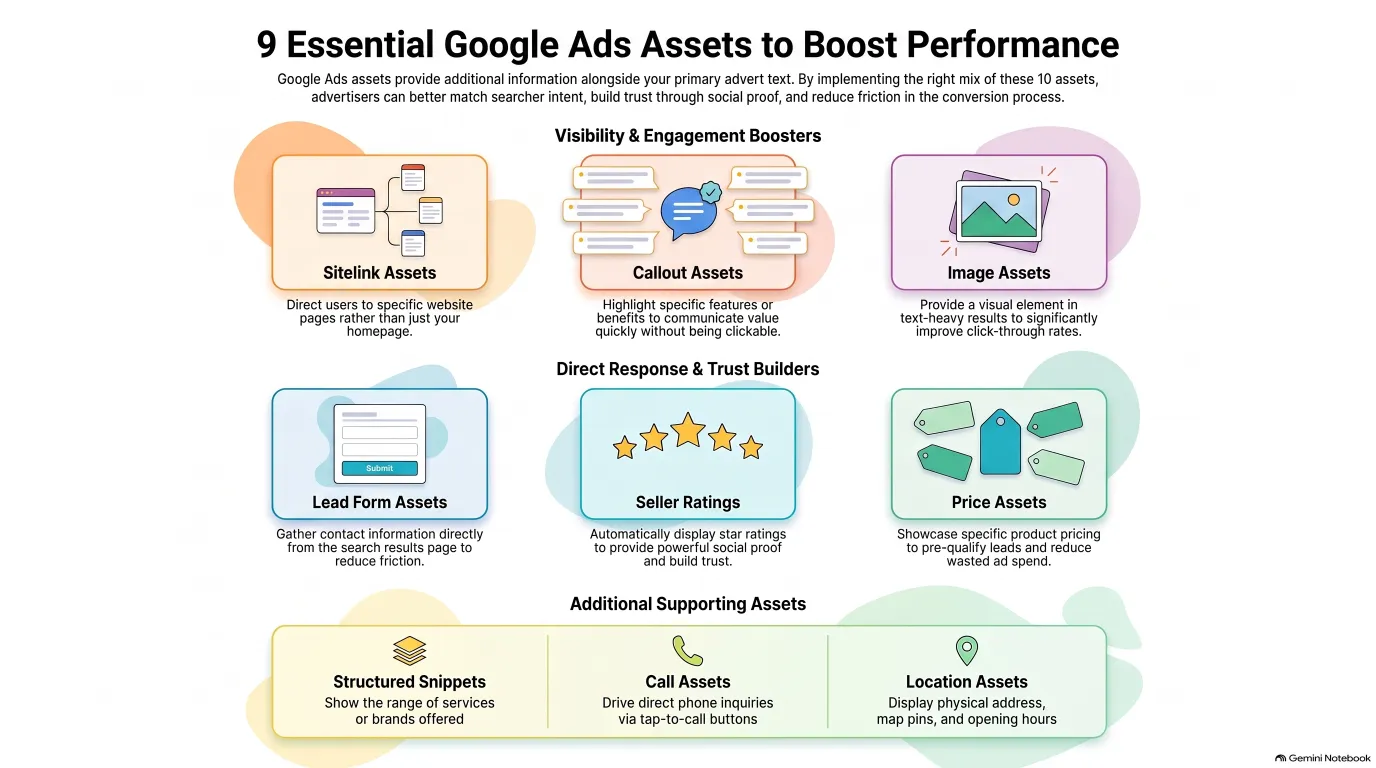
Google Ads has evolved significantly over the past few years, and one of the most impactful changes has been the expansion and renaming of what were once called ad extensions, now officially known as assets. These additions to your adverts can dramatically improve visibility, click-through rates and overall campaign performance, yet a surprising number of advertisers either ignore them entirely or only use a handful without really understanding what each one brings to the table. If you are investing budget into Google Ads and not making full use of assets, you are quite simply leaving performance on the table. This guide walks through the top 10 Google Ads assets you should be using and, more importantly, why they matter to your campaigns.
Sitelink Assets
Sitelinks are arguably the most widely used asset, and for good reason. They allow you to add additional links beneath your main advert, directing users to specific pages on your website rather than just your homepage or a single landing page. Think of them as signposts that help people find exactly what they are looking for faster. A business running ads for a software product might include sitelinks for pricing, features, a free trial page, and customer support. Each of those links serves a different type of searcher intent, and when someone finds what they need immediately, they are far more likely to click through and convert.
Make sure your sitelinks point to genuinely useful, relevant pages and that each one has a distinct destination. Avoid duplicating your main landing page URL across multiple sitelinks, as this wastes the opportunity entirely.
Callout Assets
Callouts are short snippets of text that appear beneath your advert and allow you to highlight key features, benefits or unique selling points. Unlike sitelinks, they are not clickable, so their sole purpose is to communicate value quickly. This is where you tell the world what makes your business worth choosing. Things like free delivery, award-winning service, no contracts, or 24-hour support are all strong candidates for callouts. They work particularly well when they reinforce trust and reduce hesitation in a potential customer who is comparing your advert against a competitor's.
Write callouts that are specific and meaningful rather than generic. Phrases like "great service" tell a searcher very little, whereas "same-day dispatch" or "UK-based support team" actually communicate something tangible.
Structured Snippet Assets
Structured snippets give you the ability to list specific aspects of your products or services under a predefined header such as Services, Brands, Destinations, or Courses. They add depth to your advert by showing the range or breadth of what you offer. If you run a digital marketing agency, for example, you might use the Services header to list SEO, Google Ads, Social Media, and Web Design. This signals to a searcher that they are dealing with a full-service provider rather than a specialist in only one area, which can be a deciding factor in whether they click on your advert or scroll past it.
Choose the most relevant header category and populate it with at least four strong values. Google recommends a minimum of three, but more gives the algorithm more to work with when dynamically displaying your ad.
Call Assets
For businesses where phone calls are a primary conversion method, call assets are essential. They display your phone number directly within the advert, and on mobile devices they turn into a tap-to-call button, removing any friction from the process. A user searching for an emergency plumber, a local solicitor, or a dental practice is very likely to want to pick up the phone rather than fill out a contact form, so making that option as easy as possible directly from the search results page can make a considerable difference to your inbound call volumes.
Want more insights like this?
Join thousands of marketers getting weekly tips and strategies.
Use call assets alongside call reporting within Google Ads so you can track which campaigns and keywords are actually driving phone calls and measure their value as a conversion action.
Location Assets
If your business has a physical presence or serves customers in specific areas, location assets connect your Google Business Profile to your adverts and display your address, a map pin, and even your opening hours. This is particularly powerful for businesses targeting local searchers because it adds an element of credibility and convenience. A person searching for a gym, a restaurant, or a retail store wants to know where you are before they consider visiting, and having that information appear in your advert means one less barrier between them and choosing you.
Ensure your Google Business Profile is fully completed and verified before linking it to your campaigns. An incomplete profile will undermine the value of this asset significantly.
Image Assets
Image assets can appear on Search campaigns when Google determines that they will improve performance, and they give your advert a visual element that stands out in what is otherwise a very text-heavy environment. A relevant, high-quality image alongside your advert text can make your listing far more eye-catching on a results page full of plain text adverts. This is particularly beneficial for product-led businesses, hospitality, travel, and any sector where visual appeal plays a role in the decision-making process.
Upload landscape, square, and portrait image variations to give Google the best chance of displaying your images across different devices and formats. Always use high-resolution images that accurately represent your product or service.
Lead Form Assets
Lead form assets allow users to submit their contact details directly through a form that opens within the Google search results page, without ever needing to visit your website. For businesses focused on lead generation, this can be a genuinely powerful tool, particularly on mobile where users are less likely to navigate through multiple pages to find a contact form. The form can be customised to ask for a name, email address, phone number, and even specific qualifying questions depending on your campaign objectives.
Keep lead forms short and only request information that is absolutely necessary. Every additional field you add increases the likelihood that a user will abandon the form before submitting.
Price Assets
Price assets allow you to showcase your products or services alongside their prices directly within the advert. Each entry includes a header, a description, and a price, along with a link to the relevant page. The transparency this creates is a significant advantage because it helps pre-qualify your audience. If someone sees your pricing and still clicks through, they are far more likely to be a genuine prospect than a casual browser who is surprised by the cost once they land on your site. This can improve conversion rates and reduce wasted spend on clicks from people who were never going to buy.
Keep your prices accurate and up to date. Outdated pricing in your assets creates a poor user experience and can damage trust before a conversation has even started.
Promotion Assets
When you are running a sale, a seasonal offer, or a limited-time promotion, promotion assets are the most effective way to highlight that within your adverts. They display a special offer tag with the discount or deal clearly visible, which can significantly improve click-through rates during promotional periods. Whether it is a percentage off, a fixed monetary discount, or a free gift with purchase, these assets make your offer impossible to miss. Google also allows you to schedule promotion assets to run only during specific date ranges, which is extremely useful for planned campaigns around events like Black Friday or seasonal sales.
Plan your promotion assets in advance and schedule them to start and end on the correct dates. There is little worse from a user experience perspective than clicking on an advert promising a discount that has already expired.
Seller Ratings Assets
Seller ratings are automatically generated by Google using data from trusted review platforms such as Google, Trustpilot, and other verified sources. When your business has accumulated a sufficient number of reviews and meets Google's threshold, a star rating appears beneath your advert automatically. You cannot manually add this asset, but you can work towards it by actively encouraging satisfied customers to leave reviews on platforms that feed into Google's rating system. Social proof in search results is a powerful trust signal, and adverts displaying strong ratings tend to attract more clicks than those without.
Focus on building genuine reviews across reputable platforms consistently rather than in short bursts. A steady stream of recent, positive feedback is far more impactful than a large number of older reviews that have not been added to in months.
Making Assets Work For Your Campaigns
Understanding the top 10 Google Ads assets you should be using is one thing, but the real value comes from implementing them thoughtfully and reviewing their performance regularly. Google's asset reporting within the Google Ads platform allows you to see how individual assets are performing at an impression and click level, which gives you the data you need to refine your approach over time. Assets that are not performing can be paused or replaced, and those that are working well can inform the direction of your broader creative strategy.
It is also worth noting that Google may not always show every asset on every impression. The algorithm determines which combination of assets is most likely to perform well for a given search query, device, and user context, so providing a full range of assets gives Google the most flexibility to assemble the best possible advert in any given situation. The more you give the system to work with, the better the outcomes tend to be.
If you are currently running Google Ads campaigns without a full suite of assets in place, addressing that gap should be a priority. It is one of the most straightforward improvements you can make to your account, and it costs nothing beyond the time it takes to set them up properly. Assets are not a bonus feature reserved for large advertisers with big budgets. They are a fundamental part of how effective Google Ads campaigns are built, and every advertiser should be using them to their full potential.
Ian
Ian has worked in Digital Marketing for decades, and is a Google Partner for Google Ads and an expert in onsite and technical SEO. He has worked with hundreds of clients, helping them achieve success online, through SEO, PPC and Digital Marketing, working with local businesses through to national retailers.
View all posts →Related Articles

Choosing A Pay Per Click Management Agency - How To Find The Right One For Your Business
When it comes to pay per click advertising, many business owners face a critical decision that could make or break their online marketing efforts. Do you manage your PPC campaigns in-house, or do you...

How To Increase ROI In Google Ads
Google Ads can be one of the most profitable marketing channels for your business, but it can also be one of the fastest ways to burn through your budget if you're not careful.

Does Quality Score Matter In Google Ads In 2026?
As we navigate through 2026, many advertisers are questioning whether Quality Score still holds the weight it once did in Google Ads campaigns. With Google's continuous algorithm updates and the rise...